Jeanne Eagels
Biography
It is very difficult to find accurate, verifiable information about Jeanne Eagels' early years, so there is little to report about this period of her life. She was born in Kansas City, MO, as Amelia Jean Eagles on June 26, 1890. Many periodicals and websites list her year of birth as 1894, but this is incorrect. Her parents were Julia Sullivan Eagles and Edward Eagles and she had two sisters and three brothers. Her parents were of humble origins and her formal schooling may have ended around the time she was 11. Early on Jeanne displayed a single-minded determination to be an actress. She was bitten by the acting bug after appearing in a Shakespeare play- either "A Midsummer's Night Dream" or "Hamlet". Her accounts of the first part she played differed in newspaper interviews. After playing bit parts at local theaters, she joined the Dubinsky Brothers' traveling theater company as a dancer around the age of 12. She soon worked her way into playing leading roles in classic and popular dramas, including "Camille", "Romeo and Juliet", "Uncle Tom's Cabin", and "Little Lord Fauntleroy." Jeanne fell in love with and married Morris Dubinsky, the eldest of the brothers, probably during her teens. But the relationship was not destined to last. The reasons for the separation are unknown, although infedility on Dubinky's part may have played a role. According to some accounts, she had a son by Dubinksy, but the child died in infancy, causing her to have a severe nervous breakdown. In other accounts, she and Dubinsky gave the child up for adoption to close friends. While travelling about the U.S., Jeanne accepted a part in touring company outside of the Dubinksy troupe, and eventually she reached New York City. In 1925 Eagels married stockbrocker Ted Coy (aka Edward H. Coy), a former Yale football player (1906-1910), who in the mid-1920s was one of the most admired men in the USA. This marriage was rocky, and Eagels' reputation for drinking and mood swings increased. Following the success of "Rain", Eagels was offered her choice of new plays. She either turned down offers or walked out during rehearsals for many new plays, including the opportunity to originate the role of Roxie Hart in "Chicago" (1926). In 1926, Eagels returned to the Broadway stage in the George Cukor-directed play "Her Cardboard Lover". Her leading man was Leslie Howard, best known today as Ashley Wilkes in "Gone with the Wind". Perhaps she was tired of playing floozies, and chose to play a spoiled, French divorcee in a light comedy for a change. Although Eagels had played light comedies in her early years, this play was a poor choice as a follow-up to "Rain". On opening night it was Howard who caused a sensation, not Eagels. The audience cheered for Howard to take curtain calls, but for contractual or other reasons, Eagels took Howard's curtain calls and thanked the audience "on behalf of my Cardboard Lover". This created an awkward and embarrassing situation. In the reviews, critics noted that Eagels seemed extremely nervous as she took the stage, although she got into the spirit of the show before too long. It was also noted that Eagels played an insubstantial character, and that her talents seemed better suited to dramas like "Rain". Eagels suffered from chronic sinusitis and several other disorders, which were not helped by her tendency to drink and medicate herself. As a result, her on-stage behavior during "Her Cardboard Lover" caused the curtain to come down mid-show on at least one occasion when she asked Howard for a drink of water- something not in the script. According to Howard's biographer, he stormed off the stage at that point. According to other reports, it was Eagels who left the stage, but came back after she had her drink. Still, the play was modestly successful, and Eagels would go on tour with the play to other large cities. Before "Her Cardboard Lover" went on tour, Eagels took a break in August-September 1927 to make the film "Man, Woman & Sin" with John Gilbert. This MGM film was directed by Monta Bell, who would go on to write and produce Eagels' talking film debut in 1929. This film was shot on location in Washington D.C., although there is little location footage in the final film. The rest of the film was shot at the MGM studios in California. During filming, Eagels failed to show up for work on at least a couple of days. When she did show up, she was late. John Gilbert later said he had never worked with someone as tempermental as Eagels, who evidenlty caused quite a fuss when she was working. One trade paper printed a blind item that she was keeping a Hollywood bootlegger very busy. The director (Bell) was furious when he learned that Eagels took a two week vacation to Santa Barbara without informing him. He asked MGM managment to fire her from the picture, which they did. Somehow the picture was completed without re-casting and reshooting Eagels' role. Eagels received mixed reviews, with some saying she photographed beautifully and others saying she looked haggard. The star was Gilbert, however, and his reviews were mostly negative. Having played dashing, romantic heroes, his role as a naive mama's boy in this film was too much of a stretch for critics and audiences. (In my opinion he gives a credible performance.) Shortly after the release of this film, MGM released "Love", the 2nd Gilbert-Garbo pairing, and this film overshadowed "Man, Woman & Sin" at the box office. Eagels returned to the East Coast to tour in "Her Cardboard Lover". The Boston engagement for the play was shortened from two weeks to one due to Eagels' unspecified illness. The play subsequently moved to Chicago for a longer stay. While in Chicago, Eagels divorced Coy in 1928 on grounds that he physically assulted her, including breaking her jaw. She testified that he had even threatened to "ruin that beautiful face of yours" to stop her movie career. Those close to the couple would later recall that both Eagels and Coy drank heavily. Coy pleaded no contest, and by the time the divorce was granted he was living in Texas. They had no children together. In 1928, following the Chicago engagement, the next stop for "Her Cardboard Lover" was to be Milwaukee. Eagels failed to show up for performances scheduled in Milwaukee and St. Louis. At the request of the show's producers, she was subsequently banned by Actor's Equity from performing on stage with any other Equity actors for 18 months. This essentially banned her from appearing on stage in New York, if not the whole U.S. She maintained that her failure to show up was a result of food poisoning (ptomaine). She vowed to appear in a one-woman play to thwart the ban. Despite her protests of genuine illness, first hand accounts report that she was heavily inebriated in her Chicago hotel room during the time she should have been in Milwaukee. Her drinking binge may have been the result of a romatic tiff with her current boyfriend. The Equity ban left Eagels free to perform scenes from "Rain" to vaudeville audiences and to make film appearances. She actually received more money for appearing in vaudeville and films than she received for appearing on the "legitimate" stage. Fortunately for Eagels, the advent of talking pictures made Hollywood executives desperate for famous, stage-trained actors whose voices were a sure thing. In a complete turn around, the man who had her fired from MGM, Monta Bell, told the press that if Equity didn't want Eagels, he wanted her for the movies. He said that she was a consummate professional during the filming of "Man, Woman, & Sin" and that he had urged MGM to give her a contract for more pictures. By late 1929 Bell was a producer at Paramount Pictures Astoria Studios in Long Island, NY. In 1929, Eagels was making "The Letter" for Paramount, which Bell produced. "The Letter" was adapted from a W. Somerset Maugham play that was a hit for Katharine Cornell on Broadway. Bell persuaded Paramount to sign Eagels for two more pictures. Eagels received rave notices for her performance in "The Letter". Eagels' second film was "Jealousy" (1929), which was also adapted from a Broadway play. Eagels had chosen the English actor Anthony Bushell as her leading man, but he was replaced by Fredric March in the middle of filming. It is possible that Bushell's voice recorded poorly and was unsuitable. Eagels was reported to be having a nervous breakdown on the set of "Jealousy", but this was denied by Paramount. Several years later Fredric March recalled that she was great to work with. In September, Eagels chose to opt out of her third film for Paramount ("The Laughing Lady") either because she was too sick to work or she did not care for the script. The studio released her from her obligation to make this film, which became a vehicle for Ruth Chatterton. Newspapers reported that Eagels was preparing to return to the Broadway stage in a new play for producer Sam Harris in the Fall of 1929, which is when her Actor's Equity ban expired. Harris was one of the producers behind the success of "Rain". In September, 1929, Eagles was hospitalized for surgery to treat ulcers on her eyes, which if untreated would cause blindness. This condition was attributed to her chronic sinusitis. She was treated successfully at St. Luke's Hospital in NYC, and she was said to be recovering quickly. Two weeks later on October 3, 1929, Eagels was preparing for a night out on the town, but suddenly fell ill. Her secretary escorted her to an exam room at Dr. Cowles' private, 5th Avenue hospital, but she convulsed suddenly and died. In the following months, three autopsy reports were issued, stating that the cause of death was due to an overdose of (1st) alcohol, (2nd) the tranquilizer chloral hyrdate, and (3rd), heroin. It may be safe to say that to some degree all three substances were in her system at the time of her death. Another suggested cause of her death was that as Eagels was unconscious, having been given a sedative by the first doctor to see her, a second doctor unknowingly gave Eagels a second shot, and this overdose lead to her death. At first, policemen told reporters that she died in an evening gown wearing over $250,000 worth of jewelry. Subsequent evaluation by an expert indicated that her jewelry was worth no more than $5000. Eagels' estate was worth about $52,000 after her debts and funeral costs were deducted, and since she left no will, this was paid to her mother. Jeanne Eagels' wake was held at Campbell's funeral home in NYC, the site of Rudolph Valentino's services when he died three years earlier. Her last film, "Jealousy" was reported to be playing across the street from Campbell's. Another service with a Catholic high mass and requiem was held in Kansas City, where Eagels' body was laid to rest in a cemetery next to her father and a brother who pre-deceased her. Her grave is marked "Jeanne Eagles" with the original spelling of the family name. In early 1930, Eagels was posthumously nominated for a 1929 Best Actress Academy Award for her role as Leslie Crosbie in "The Letter". She lost to crowd-pleaser Mary Pickford in "Coquette", which was Pickford's talking picture debut. In 1930, Edward Doherty wrote a biography of Eagels that was initially printed in serial form for a tabloid. Doherty was a reporter who made his reputation covering Hollywood scandals such as Fatty Arbuckle's trial for murder, and Wallace Reid's death from heroin addiction. Eagels' mother and sister sued to prevent publication of Doherty's biography, but the court reluctantly ruled in Doherty's favor. The NY Times Book Review noted that Doherty's biography started out on solid ground, but that it included private conversations he couldn't possibly have been privy to and other embellishments. Morris Dubinsky died one month after Jeanne. Ted Coy died from pneumonia in 1935, having filed for bankruptcy in 1933. Eagels' mother died in Beverly Hills in 1945. Jeanne Eagels' tragic life has inspired at least one play and a few films, including the 1957 film "Jeanne Eagels" starring Kim Novak. This film is a rather tepid version of Eagels' life, and is more fiction than fact. If Eagels is remembered today, it is often for this film, or for her drug-overdose death. http://www.jeanneeagels.com/

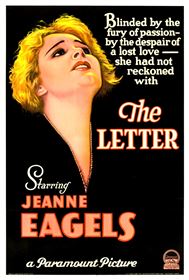
The Letter
Leslie Crosbie
The Letter
Leslie Crosbie


